
HALO stocks: a new investment strategy or just the latest Wall Street story?


Wall Street has a shiny new acronym for investors to chase. But strip away the marketing and HALO stocks look suspiciously like a familiar investment story — repackaged with a catchy label, amplified by financial media, and already being turned into products you don't need.
The investing industry has a long history of inventing new names for old ideas. It's good for business. A fresh label generates media coverage, the media coverage creates demand, and the demand justifies new products. The people who benefit most from this cycle are rarely the investors.
So when HALO stocks started appearing everywhere this year, from Goldman Sachs research notes to the weekend financial pages, I wanted to look at what was actually underneath the label.
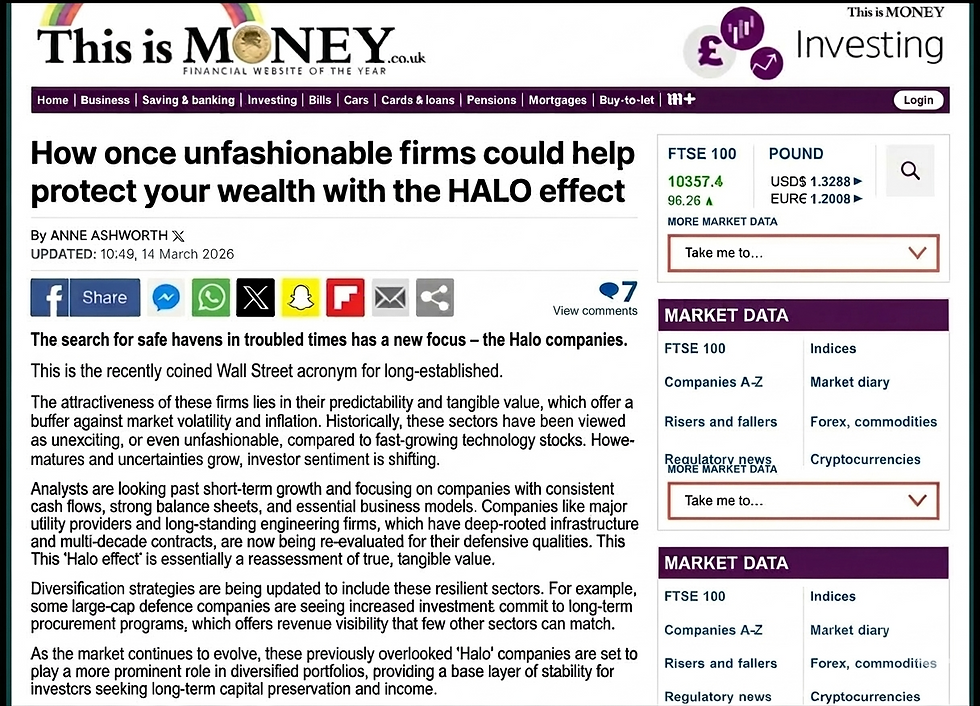
HALO stands for Heavy Assets, Low Obsolescence. The idea is simple: in a world where AI threatens to disrupt software companies and digital businesses, investors should favour firms with physical assets that can't easily be replaced. Utilities, energy companies, miners, industrials. The term was coined by Josh Brown, CEO of Ritholtz Wealth Management, in a Substack post on 8 February 2026. Within 16 days, Goldman Sachs had published a research note called The HALO Effect. Within 19 days, two ETF providers had filed HALO-branded products with the US Securities and Exchange Commission. Within weeks, UK newspapers were telling readers which HALO stocks to buy.
That's a remarkable pace. It's also a familiar one.
I have a good deal of time for Brown and his colleagues and for Ritholtz as a firm, which has a broadly evidence-based investment philosophy. My co-author Ben Carlson, one of the nicest guys and very best investment writers, works there. But Ritholtz has always liked to play with fire. Its media output thrives on market commentary and sector calls, content that generates clicks but doesn't always help investors over the long term. HALO fits that pattern: a smart observation about market dynamics, packaged in a way that's irresistible to financial media. The problem starts when an observation becomes a strategy, and a strategy becomes a product.
Think of it like a film sequel. The cast is familiar: value stocks, infrastructure, industrials. But the poster is new, the tagline is catchier, and the ticket price is higher.
"The problem starts when an observation becomes a strategy, and a strategy becomes a product."
The plot is familiar, and Goldman admits it
Goldman's research note, The HALO Effect: Heavy Assets, Low Obsolescence in the AI Era, landed on 24 February 2026. Authored by strategists Guillaume Jaisson and Peter Oppenheimer, it makes an impressive-sounding claim: Goldman's basket of capital-intensive European stocks has outperformed its capital-light equivalent by roughly 35%.
That number deserves unpacking.
The 35% figure compares two proprietary baskets constructed from STOXX 600 companies over roughly 14 months from January 2025. Goldman built a Capital Intensity Score blending six accounting metrics to sort companies into heavy and light camps. It's reasonable enough as far as it goes. But 14 months, one region and a bespoke basket don't tell you whether an effect will persist. They tell you what happened recently.
Here's where it gets interesting. Buried in the report's exhibits is a chart showing the capital-intensive vs. capital-light dynamic plotted alongside value vs. growth from 2010 to 2026. The two lines move almost in lockstep.

Goldman doesn't hide this. The report states that the dynamic 'closely tracks the Value vs. Growth rotation'. Goldman's own data suggests investors are looking at a familiar factor rotation in new clothing.
What the report doesn't do is engage with the academic literature that might test this. No reference to the Fama-French factor models. No discussion of quality or profitability as established return drivers. No attempt to show HALO is a distinct effect independent of value. 24 pages introducing a supposedly new investment framework, and not a single academic citation.
To its credit, Goldman hedges at the end. 'Whether this marks a lasting change in market leadership or simply a re-balancing within a still evolving cycle remains open,' the report concedes. That's an unusually candid admission for a note that spent the preceding 23 pages arguing the opposite.
Same plot. New title card.
"24 pages introducing a supposedly new investment framework, and not a single academic citation."
From Substack fiction to ETF filing in three weeks
The timeline tells the story.
On 22 February 2026, a small research outfit called Citrini Research published a piece of speculative fiction on Substack. Titled The 2028 Global Intelligence Crisis, it imagined an AI-driven economic collapse: mass white-collar layoffs, a deflationary spiral, the S&P 500 down 38%. The piece racked up roughly 16 million views on X. It was swiftly debunked. Citadel Securities published a detailed rebuttal. The White House Council of Economic Advisers called it science fiction.
But the fear it tapped into was real. Software stocks sold off. Investors rotated into companies with physical assets. The HALO narrative found its moment.
Five days later, two ETF providers filed HALO-branded products with the SEC within minutes of each other. Roundhill Investments proposed a fund with the ticker HALO at an estimated expense ratio of 0.59%. Tuttle Capital Management reportedly filed a competing product at 0.75%. Both are actively managed, using proprietary screening models rather than transparent, rules-based indices. And on 25 February, Ritholtz Wealth Management itself filed for its first ever ETF, a sign of just how quickly the line between market commentary and product manufacturing is blurring.

For context, a global index fund charges roughly 0.07% to 0.22%. A low-cost, value-tilted fund might charge 0.20% to 0.30%. The HALO ETFs would cost two to three times more for what Goldman's own research suggests is substantially a value rotation.
A blog post on 8 February. Dystopian fiction on 22 February. Two product filings on 27 February. The studio greenlit the sequel before anyone had reviewed the original.
HALO stocks join a long line of thematic flops
HALO has the narrative. It has the acronym. The products are being filed. The only part of the pattern still missing is the disappointment.
HALO stocks aren't the first time the investing industry has packaged a compelling narrative into a product. But the track record should give any investor pause.
A 2023 study in the Review of Financial Studies examined what happens to specialised ETFs after launch. Over their first five years, these products lost roughly 30% on a risk-adjusted basis. The cause wasn't fees, although those didn't help. The underlying stocks were already overvalued by the time the ETF launched. The researchers concluded that providers issue thematic products to cater to investors' extrapolative beliefs, launching funds that ride the tail end of a trend rather than the beginning.
Morningstar's data reinforces the point. Of all global thematic funds available in mid-2024, only 9% had both survived and outperformed a broad equity index over the previous 15 years. Fewer than one in ten.
The pattern repeats decade after decade. In the 1960s and 70s, the Nifty Fifty were the 'one-decision' blue-chip stocks everyone had to own. They crashed in 1973–74. In the early 2000s, the BRICs narrative convinced investors that exposure to Brazil, Russia, India and China was the path to superior returns. Goldman Sachs coined the acronym. Goldman also closed its own BRIC fund in 2015 after years of disappointing performance. More recently, clean energy, genomics and metaverse funds surged on pandemic-era enthusiasm, attracted billions in inflows, then collapsed.
Every decade produces its blockbuster investment franchise. A narrative that feels irresistible. An acronym that sticks. Products that follow fast. And returns that disappoint.
HALO has the narrative. It has the acronym. The products are being filed. The only part of the pattern still missing is the disappointment.
Why investors keep falling for the same story
If the evidence against thematic investing is so clear, why do investors keep buying in?
Because the stories are good. And we're wired to respond to good stories, especially when markets feel uncertain.
HALO offers a beautifully simple narrative: AI will disrupt software, so buy things AI can't replace. It feels like common sense. But feeling logical and being supported by long-term evidence are different things.
There's recency at work too. Software stocks have had a brutal stretch. It's natural to assume the shift is permanent. But extrapolating recent performance into the future is the pattern that leads investors to buy thematic products at the worst possible moment, right after the rotation has already happened.
And there's the comfort of things you can touch. A pipeline feels more real than a factor premium. A power station feels safer than a spreadsheet showing decades of value outperformance. Tangibility is reassuring. But it isn't a return driver. It's a psychological comfort blanket.
This is why the sequel keeps getting made. The trailer looks compelling. The plot sounds fresh. We convince ourselves that this time the follow-up will match the original.
It rarely does.
What evidence-based investors should do instead
If you hold a diversified global portfolio, you already own HALO stocks. A total market index fund contains utilities, energy companies, miners, industrials and infrastructure firms. You don't need a thematic ETF to own ExxonMobil, National Grid or Rio Tinto. They're already there.
The characteristics the HALO narrative claims to have discovered aren't new. The Fama-French five-factor model identified value, profitability and investment as systematic drivers of expected returns decades ago, backed by peer-reviewed evidence across markets and time periods. Goldman's own research shows the HALO trade tracks value vs. growth closely. What's being sold as a fresh insight is largely a set of well-understood factor exposures with a new label.
If you want deliberate exposure to those factors, you can get it cheaply and systematically. Providers like Dimensional Fund Advisors, Avantis and Vanguard offer rules-based funds targeting value, profitability and other evidenced factors at a fraction of thematic ETF fees. The methodologies are transparent, the costs are low, and the academic foundations are solid.
Four things worth keeping in mind. Don't chase investment narratives, however compelling the story. Check whether you already own the exposure through your existing holdings. If you want factor tilts, use low-cost funds with clear, rules-based methodologies. And remember that by the time a strategy has its own acronym, the opportunity it describes has probably already passed.
The original film is still the best. And the ticket is much cheaper.
The best investment stories are the ones you don't follow
There will be another acronym. There always is. Another research note, another pair of ETF filings, another round of weekend press coverage explaining why this time is different. The sequel will get made, because sequels make money for the studios that produce them.
HALO contains a grain of truth. Physical assets do have durable economic value. But that doesn't justify a new investment strategy, a new product, or a premium fee. It certainly doesn't justify rearranging your portfolio on the basis of a narrative that's been circulating for barely a month.
The pattern will repeat. A new label, a media blitz, a rush to file products. And the people most likely to benefit will be the ones selling it, not the ones buying it.
Evidence-based investors already own the whole market. Every utility, every pipeline, every mine, every factory. Cheaply, systematically, and without paying for a story.
That's not a sequel. It's the original. And it still works.
Resources
Ben-David, I., Franzoni, F., Kim, B., & Moussawi, R. (2023). Competition for Attention in the ETF Space. Review of Financial Studies, 36(3), 987–1042.
Goldman Sachs Global Investment Research. (2026). The HALO Effect: Heavy Assets, Low Obsolescence in the AI Era. 24 February 2026. Authors: Guillaume Jaisson, Peter Oppenheimer.
If you're unsure whether your portfolio is built on evidence or on stories, it might be worth talking to an adviser who knows the difference.
The advisers in our evidence-based adviser directory are all committed to an evidence-based approach. They won't chase the latest acronym on your behalf. They'll help you build a portfolio designed to work over decades, not just the next news cycle.
Note: this service is only available to UK nationals resident in the UK.


