
Why Vanguard is called Vanguard

50 years ago this week, the first index fund for ordinary investors went on sale and almost nobody bought it. The company behind it had been named, two years earlier, after a ship in a picture on its founder's wall. Neither the name nor the founding story explains why any of it worked.
In the late summer of 1974, a dealer in antique prints called on Jack Bogle at Valley Forge in Pennsylvania. It was not a promising moment. Bogle had lost control of Wellington Management after a merger he had engineered went badly. The prints on his office wall were company property, and they had gone in the split. He bought a dozen replacements depicting the Napoleonic Wars, among them Nelson's naval battles.
Grateful for the sale, the dealer handed over the book the naval prints had been lifted from, Naval Battles of Great Britain 1775–1815. Leafing through it, Bogle came across Nelson's dispatch after the Battle of the Nile in 1798, and beneath the signature, the ship it was written aboard: HMS Vanguard.

The timing was lucky. The new fund administration company Bogle was setting up was weeks from incorporation, and he had been told he could not use the Wellington name. The alternatives on the table were Victory, which he thought grandiose, and Mutual Fund Management Company, which he thought bland. Wellington's directors read Vanguard, correctly, as a signal that Bogle had ambitions beyond clerical work. They relented anyway. The nautical theme then took over the firm: staff became crew, the canteen became the Galley.
What the Vanguard name was attached to
Vanguard was incorporated on 24 September 1974 with a staff of 59. It was owned by the funds it administered, which between them ran about $1.4 billion, and it was structured to operate at cost, returning any profit to those funds.
Nobody noticed. Forbes ran a hostile piece in May 1975 under the headline 'A Plague on Both Houses?', which infuriated Bogle, but otherwise the arrival of a fund company owned by its own investors went unremarked. Wellington's funds were then partway through 40 consecutive months of outflows, a run that would not end until January 1978.
A gambit, not a mission
Vanguard's mandate barred it from investment management. Bogle's way round this, put to the board on 18 September 1975, was that a fund which merely tracked an index was not managed at all. The board accepted the argument.
Robin Wigglesworth is unsentimental about the motive. In Trillions, his history of index investing, he calls the birth of the first index fund for ordinary investors 'no grand mission, merely a strategic gambit in his ongoing war with the Bostonians'. Bogle's assistant at the time, Jan Twardowski, says much the same: the later account, in which Bogle had foreseen where indexing would lead, is not what those around him remember.
Nobody wanted it
Bogle told his board to expect $150 million from the initial offering. He then ran a betting pool on the outcome. Two of his own colleagues said around $30 million each. A recently arrived executive, Bob Lippman, entered $11,111,111 and won.
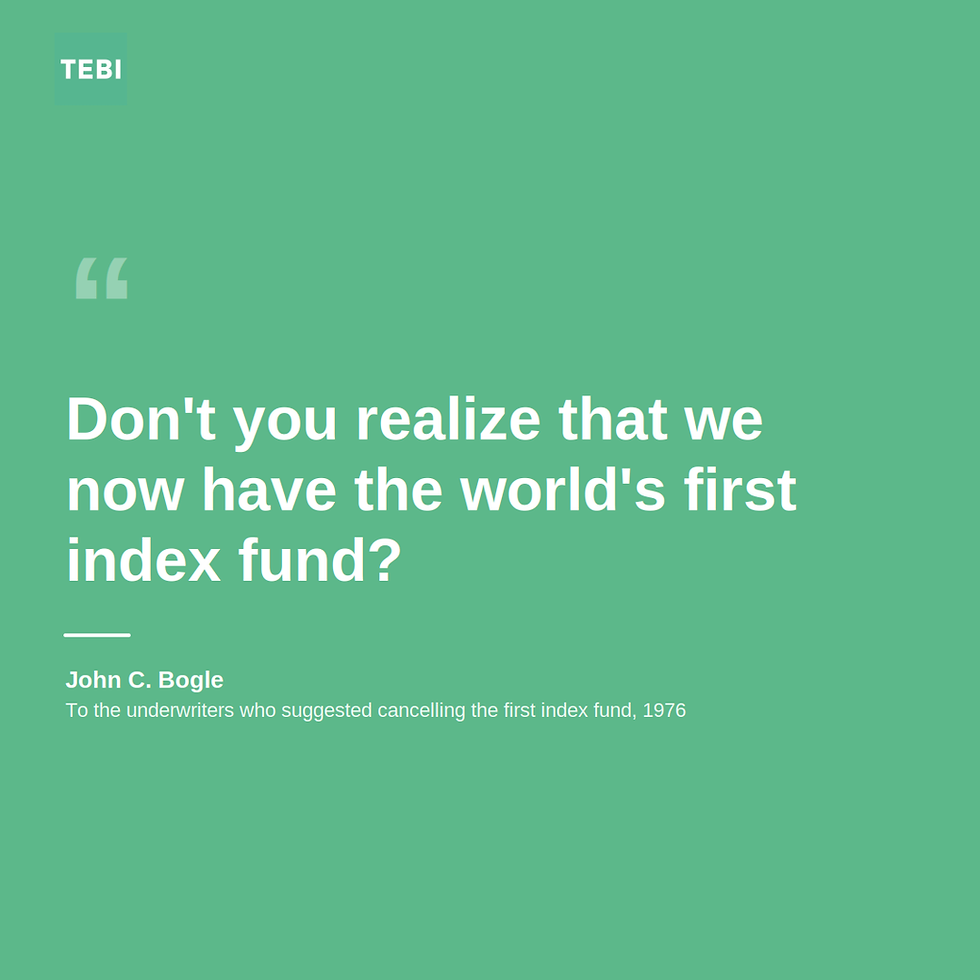
The First Index Investment Trust raised $11.32 million on 31 August 1976, not enough to replicate the S&P 500, so it bought 280 of the 500 stocks. The underwriters offered to scrap the launch. Bogle told them to proceed. The press called it Bogle's Folly. By the end of the year it held $14 million.

Fidelity's chairman, Ned Johnson, told the Boston Globe his firm would not be following, on the grounds that investors would never settle for average returns. 50 years on, the same objection is still being made, by people with weaker evidence than he had.
The part the story leaves out
Almost nothing here was planned. The name came off a print that Wigglesworth notes Bogle only took to be the Vanguard. The at-cost structure came out of a defeat. The fund existed because its founder needed a route around his own mandate, and when it launched, it failed.
But none of that mattered, because the arithmetic never depended on it. The draft prospectus projected operating expenses of 0.3 per cent a year and transaction costs of 0.2 per cent, roughly a tenth of the all-in cost of an actively managed fund at the time, and those figures held whatever Bogle's motives were, just as the principle holds now: fees remain the most reliable predictor of fund performance. The ownership structure that made those costs possible is the part of the story no UK fund house has copied, and the part British investors would benefit from most.
So the founding story turns out to be the least important thing about the founding.
That is worth holding on to this week, because the story is what everyone is celebrating. Including, I should say, me. Mark Hebner had the idea of marking the anniversary with a ballad, and my colleagues at Regis Media set it to music and made the film below. Bogle has a better claim on a legend than almost anyone in this industry. He just didn't earn it with a name.
Resources
Bogle, J. C. (2011). The professor, the student, and the index fund. Retrieved from johncbogle.com
Wigglesworth, R. (2021). Trillions: How a band of Wall Street renegades invented the index fund and changed finance forever. Penguin.
Liked this article? Get more like it from the TEBI Digest, our free email newsletter. Just add your email address to the 'Subscribe' box at the foot of our homepage.


